

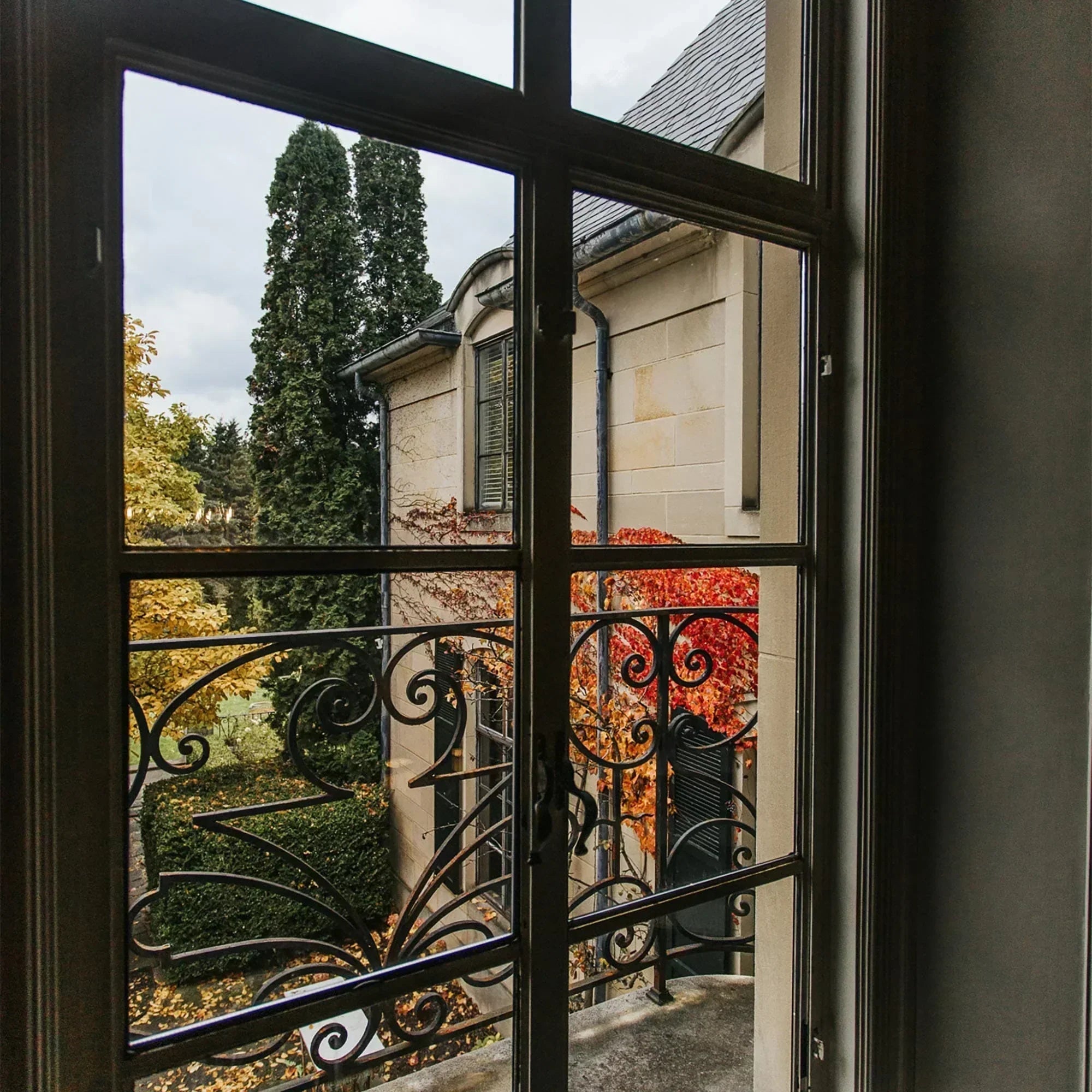
This visit felt like the real beginning.
Not the planning. Not the ideas. But the moment where we stepped into the space and allowed it to guide us. Our first trip to Greencrest Manor was less about making decisions and more about paying attention.

Arriving in the Middle of Fall (Just in Time)
Living in Arizona, I don’t get much exposure to true seasonal change. So when we scheduled our first off-season visit to Greencrest in November, I was holding my breath.
I kept thinking we might be too late. That fall would already be gone. That a cold snap would come through and strip the trees before we ever arrived. Watching friends post vibrant fall colors online while my flight was still days away felt almost cruel.
Then we landed.
The sun was golden. The air was warm. The trees were still bursting with yellows, oranges, and reds. It felt like the timing couldn’t have been better if we tried.
We immediately pulled out the drone. Capturing the exterior mattered just as much as what would happen inside. The grounds are such a huge part of Greencrest’s identity, and so much of what we’re designing is inspired by bringing that outdoor beauty inward.

Seeing Greencrest in a Different Season
Greencrest is most often seen during summer wedding season, when the gardens are in full bloom and everything feels lush and romantic.
But fall brought something different.
The ivy draped across the manor had deep red and orange leaves. The grass was still green. The lake behind the property reflected the changing trees. It felt warm, layered, and inviting in a quieter way.
One of the guiding principles for this collection is that it must feel cohesive year-round. Standing there in fall confirmed that the designs couldn’t feel tied to one season. They needed to feel timeless.

Slowing Down Inside the Manor
Once inside, we slowed everything down.
This first visit wasn’t about deciding where wallpaper would go. It was about understanding the spaces. Some rooms would call for it immediately. Others wouldn’t need it at all. And some would need something subtle rather than bold.
We were looking for opportunities, not obligations.
Small niches. Architectural details. Ceilings. Moments where wallpaper could enhance what already existed rather than overpower it.

The Garden Room: A Natural Starting Point
The Garden Room quickly stood out.
Sunlight filled the space, bouncing off white walls and creating a calm, airy feeling. It didn’t feel unfinished, but it did feel like a place where wallpaper could add depth and warmth without disrupting its simplicity.
This was one of the first spaces where the idea felt intuitive.

Thoughtful Details in the Dining Room
In the dining room, the walls were already saturated in a rich forest green. Rather than adding more to the main walls, we noticed the built-in cupboards.
That’s where the opportunity was.
A quiet moment. A peek of pattern. Something you notice when you’re close, not something that demands attention from across the room.

Upstairs: Spaces That Required Extra Care
Upstairs brought a different kind of energy.
The bridal suite is soft, light, and intentionally feminine. It’s also one of the most photographed rooms in the manor. Jenn is understandably protective of it.
Wallpaper here would need to feel intentional, not trendy. Something that enhances the experience rather than competes with it.
The attached bathroom offered another layer of opportunity, where a focal wallpaper could be paired with a complementary pattern to create continuity throughout the suite.
The Burt Suite presented similar considerations. The millwork and wainscoting created natural frames where a mural or focal design could live comfortably. From there, we could extend softer patterns into the vestibule, closet, and en suite bathroom.

Knowing When to Leave a Room Alone
As we continued through additional rooms, including the Geranium Room, the Fern Room, powder rooms, and several others, one thing became clear.
Not every space wanted wallpaper.
And that mattered.
Restraint is just as important as creativity. Some rooms felt complete as they were, and honoring that was part of the process.

Asking Questions Before Making Choices
Throughout the tour, we asked questions constantly.
Who uses this room?
What moments happen here?
Is it a gathering space or a quiet one?
Where does the light fall throughout the day?
Where are photos typically taken?
If a wall is frequently photographed, how can we elevate that moment?
If a space is often overlooked, how can we make it feel intentional?
Every decision needed context.

Learning Jenn’s Design Perspective
We paid close attention to the artwork, color choices, and overall aesthetic already present throughout the manor. Jenn’s style is layered, eclectic, and rooted in old-world charm. Think collected interiors, English influence, and a sense of history that feels lived-in.
Turning that into a wallpaper collection was always going to be complex, and that’s what made it exciting.
Jenn works in luxury weddings. She understands pattern, scale, and how to carry a theme through an entire experience. I came into this visit ready to listen and learn.
Her background in florals also made something very clear, the gardens needed to play a role inside the home.

Samples as Conversation Starters
I brought a wide range of wallpaper samples. Different scales. Different patterns. Different color palettes.
This visit wasn’t about approval. It was about reaction.
What felt right immediately?
What sparked conversation?
What felt wrong without needing explanation?
Those responses would guide everything we presented on our second visit.

Leaving with Clarity (and a Lot to Process)
We filmed the entire visit. The tour. The discussions. The moments of excitement and the moments of overwhelm.
There were times when the scale of the project felt daunting. And other moments where everything aligned so perfectly it felt effortless.
This wasn’t about imposing my vision. It was about honoring Jenn’s vision and translating it into a collection that would also live cohesively within Urbanwalls.

What This First Visit Gave Us
When we left Greencrest, we didn’t have a finished collection.
But we had something far more important.
Direction.
We understood the tone, the priorities, and the rooms that mattered most. We knew what needed to be presented on our next visit and how intentional every decision would need to be.
This first trip wasn’t about answers.
It was about listening.
And it laid the groundwork for everything that followed.


